
Dumpster and Porta Potty Quotes Blog
ADA Porta Potty Rules
Reviewed 8 November 2026
When an accessible unit is needed, how many to provide, and what makes one truly usable.
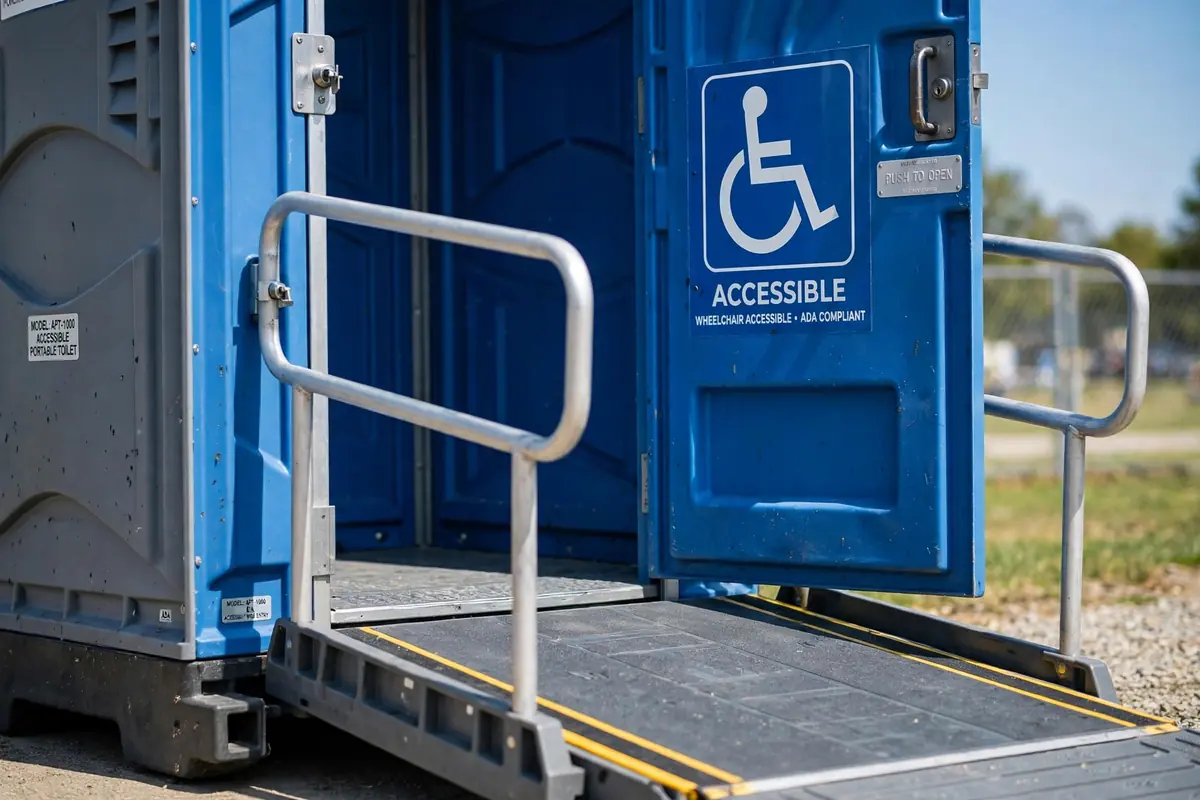
As a general guide, at least 5 percent of the portable toilets at a public event should be accessible, with a minimum of one unit. An event with 20 units would usually include at least one accessible unit, and a larger event would include more. An accessible unit has a wider door, a ramp, grab bars, and room inside for a wheelchair user to enter, turn, and transfer to the toilet. This guide explains when an accessible unit is needed and how to place it well — but it is not legal advice. Check your local rules and the venue requirements for your event, because the rules can vary by place and by event type.
Accessible restrooms are about welcome. A guest who uses a wheelchair, a walker, or a mobility aid should be able to use the facilities at your event with the same ease and dignity as any other guest. A standard unit with a narrow door and a step up simply does not work for that guest, and the fix is simple: include at least one unit built for access. The cost is modest — an ADA porta potty typically costs $200 to $450 for a weekend event, with prices that vary by location — and the difference it makes to a guest is large.
When Do You Need an ADA Porta Potty?
Public events, festivals, concerts, and community gatherings usually need accessible units. The Americans with Disabilities Act sets access standards for places of public accommodation, and portable toilets provided for a public event fall under that idea. Private events, such as a backyard party or a family gathering, are not always covered by the same rules, but including an accessible unit is good practice whenever a guest with a disability may attend.
A simple way to decide is to ask two questions. First, is the event open to the public? If yes, include accessible units. Second, do you know of any guest, worker, or attendee who uses a wheelchair or a mobility aid? If yes, include an accessible unit even for a private event. If you are unsure, include one anyway. The cost is small, and no guest is ever made worse off by having an accessible option available.
Note: Rules for accessible toilets vary by city, county, and venue. A permit office or venue manager can confirm what your event needs, and your provider can confirm which units meet the access standard.
How Many ADA Porta Potties Do You Need?
The 5 percent guide is the most widely used rule for public events. The table below shows how it works in practice. Always include at least one accessible unit, even for a small event, because a single guest who needs one cannot use a standard unit at all.
| Total portable toilets | Accessible units (5% guide) |
|---|---|
| 1–10 | 1 |
| 11–20 | 1 |
| 21–40 | 2 |
| 41–60 | 3 |
| 61–80 | 4 |
| 81–100 | 5 |
The 5% rule comes from the ADA Standards for Accessible Design. The U.S. Access Board explains it in Chapter 6 of its guide to toilet rooms, which covers how many accessible units a cluster of portable toilets needs.
For a large festival, spread the accessible units across the site instead of grouping them all in one place. A guest who uses a wheelchair should not have to cross the whole grounds to find the one unit they can use. Place an accessible unit near each main group of toilets, near the entrance, and near the seating area, so access is available wherever guests gather.
What Makes a Porta Potty ADA Compliant?
An accessible unit is larger than a standard porta potty, and the differences are easy to spot once you know what to look for. The unit should have a door wide enough for a wheelchair, usually around 32 inches or more, with a ramp or a ground-level entry so there is no step up. Inside, there should be enough floor space for a wheelchair user to turn around, grab bars on the walls, and a toilet seat at a height that allows a transfer from the chair.
- Wide door. The door should open wide enough for a wheelchair to pass through, and it should be easy to open and close from a seated position.
- Ramp or level entry. A ramp with a gentle slope, or a unit that sits at ground level, lets a wheelchair user enter without help.
- Interior turning space. The inside should have room for a wheelchair to turn, usually a clear circle of about 60 inches.
- Grab bars. Bars on the walls beside and behind the toilet give support during a transfer.
- Seat height. The toilet seat should sit at a height that matches a wheelchair seat, so a transfer is smooth.
- Easy-to-reach fixtures. Toilet paper, hand sanitizer, and the door lock should all be within reach from a seated position.
Not every unit labeled accessible meets the same standard, so ask the provider what features their accessible unit includes. A good provider will describe the door width, the ramp, the interior space, and the grab bars without hesitation. If the description is vague, ask for the unit dimensions before you book.
Where Should You Place an ADA Porta Potty?
Placement can make or break an accessible unit. A unit with a perfect interior is useless if a guest cannot reach it. Place the accessible unit on flat, firm ground near a main path, with a clear route from the entrance, the parking area, and the seating. Avoid grass that turns to mud, gravel that catches wheels, and slopes that make the approach tiring.
Keep the area in front of the door clear. A wheelchair user needs space to approach, open the door, and enter, and that space should not be blocked by a fence, a table, or another unit. Place the unit so the door opens onto a flat surface, not onto a slope or a step. If the ground is uneven, ask the provider to place the unit on boards or a firm pad, and to check that the ramp sits flush with the ground.
Tip: Walk the route yourself before the event, from the parking area to the accessible unit. If the path feels long, rough, or steep to you on foot, it will feel far worse from a wheelchair.
How Much Does an ADA Porta Potty Cost?
An accessible unit costs more than a standard unit, because it is larger and takes more effort to deliver and service. Typical prices are $200 to $450 for a weekend event, or $250 to $500 per month for a construction rental, and prices vary by location and delivery distance. The price usually includes delivery, setup, pickup, and the same servicing as a standard unit.
When you get a quote, check that the accessible unit is listed as a separate line item, with its own price and service schedule. That way you can see exactly what you are paying for it, and you can confirm that the provider will service it on the same schedule as the other units. An accessible unit that is not serviced becomes unusable faster, because it is often the only unit some guests can use.
What Else Should You Consider?
Think about the whole experience, not just the unit. A handwashing station placed near the accessible unit helps every guest, and a unit with a sink inside is an option if you want handwashing built in. Signage helps too: a clear sign with the access symbol, placed where guests can see it from the main path, lets guests find the unit without asking. Lighting matters for evening events, because a dark path to the restroom is a barrier for everyone, and especially for a guest with limited mobility.
For a wedding or a formal event, some hosts worry that an accessible unit will look out of place. It will not. Providers can place the unit behind a screen or a hedge, just like any other unit, and guests will simply see a restroom that is easy to use. A luxury restroom trailer with an accessible stall is another option for a formal event, and it gives every guest a comfortable, indoor-style restroom.
As a nationwide quote-matching service, we connect you with independent local providers who carry accessible units in your area. Tell us the event size and the date, and we will match you with providers who can confirm the right number of accessible units and give you a clear quote. Call (855) 645-2976 for a free, no-obligation quote.
When you are ready to book, our porta potty rental page lists the accessible units and the sizes that pair with them.
Frequently Asked Questions
How many ADA porta potties do I need?
As a general guide, at least 5 percent of the portable toilets at a public event should be accessible, with a minimum of one unit. An event with 20 units would usually include at least one accessible unit, and a larger event would include more.
What makes a porta potty ADA compliant?
An accessible unit has a wider door, a ramp or ground-level entry, grab bars, and enough interior space for a wheelchair user to enter, turn, and transfer to the toilet. The door should be easy to open and close from a seated position.
How much does an ADA porta potty cost to rent?
An ADA-accessible unit typically costs $200 to $450 for a weekend event, or $250 to $500 per month. Prices vary by location, delivery distance, and the provider.
Do private events need an ADA porta potty?
Private events are not always covered by the same rules as public events, but including at least one accessible unit is good practice whenever guests with disabilities may attend. Your local rules and the venue may also require one.